INFA • PRESS / BLOG

Why Infa is a new living layer of the internet

The official Infa blog: product thinking, Life Logic, and the ideas that make Infa different from social networks and marketplaces.

🔍
4 articles
Infa: The Live Visibility Layer Built For A World Searching In Real Time
GLOBAL VISIBILITY

Infa: The Live Visibility Layer Built For A World Searching In Real Time

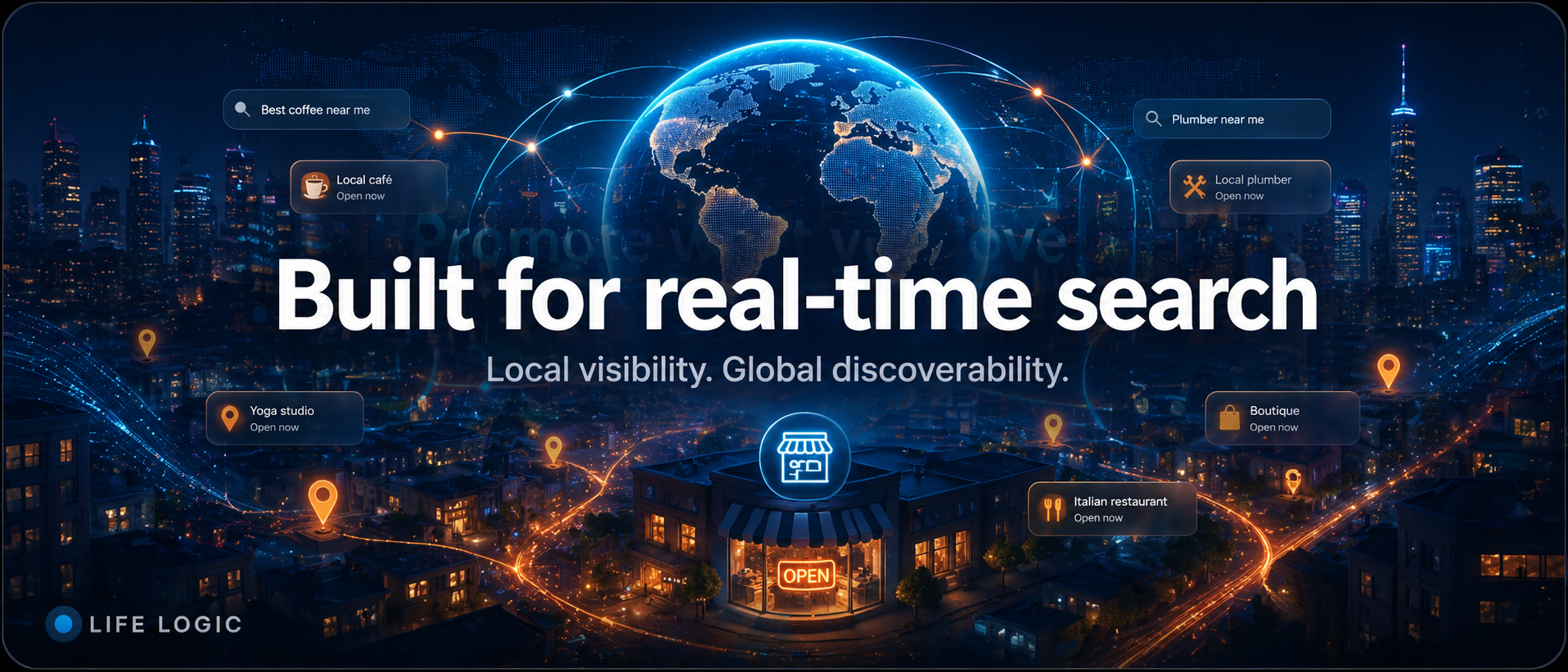
Infa is a live layer of global visibility — turning posts, offers, events, services and sponsor signals into public, indexable, AI-readable pages built for real-time search.

GLOBAL VISIBILITY Core story of the Infa platform

Infa: The Live Visibility Layer Built For A World Searching In Real Time

The internet has never had more information — and yet, for many people and small businesses, being found has never felt harder.

A restaurant may have a social page. A hotel may have a website. A repair service may have a map listing. A local seller may post in a group. An event organizer may publish an announcement somewhere online. But in practice, much of this information disappears into closed feeds, slow search results, expensive ad systems, or platforms that control who gets seen and when.

Infa is being built to solve that problem in a simple but powerful way.

Infa is not just a platform for posts. It is a live layer of global visibility. Any user, business, partner, service, local event, creator, agent or community can create a public page in seconds — and that page immediately becomes part of an open search infrastructure.

That is the key difference.

From a simple page to an open search signal

On many platforms, a post lives inside a closed ecosystem. It may be visible only to followers, only inside an app, only for a short time, or only if the platform’s algorithm decides to show it. Infa takes a different approach.

Every useful signal — a post, offer, event, service, sponsor card, local announcement or business page — can receive a public URL, SEO metadata, canonical structure, sitemap visibility, JSON data and an AI-readable format.

For a person, it looks like a clean and simple page.

For a search engine, it becomes an indexable URL.

For an AI search system, it becomes a structured object with a title, description, zone, category, freshness, public status, sponsor status and canonical link.

This matters because search is changing. People are no longer looking only through traditional search engines. They are using Google, Bing, Yandex, Baidu, AI assistants, smart agents, local discovery tools and future search systems that read open web data. Infa is designed for that new reality.

The idea is simple: if something useful exists in Infa, it should be findable.

Not only inside Infa.

Not only in one city.

Not only in one country.

It should be discoverable through the open internet.

Local relevance with global discoverability

For local businesses, this can be especially powerful. A salon in Bangkok, a hotel in Phuket, a restaurant in San Francisco, a repair service in Moscow, a seller in Hong Kong, a tourist operator in Rayong or an exhibitor at an international event can create an Infa post in minutes.

That post can appear in its local zone, receive a public page, become part of a feed, and be prepared for search engines and AI systems.

Instead of waiting months for SEO or paying more and more for ads, the business gets a fast, structured visibility signal.

Infa connects two things that are usually separated: local relevance and global discoverability.

A post may be created for a specific zone — for example San Francisco, Moscow, Bangkok, Rayong or Hong Kong — but its structure can be understood by the wider internet. It is local for the people nearby, but readable globally by search systems.

That is what makes Infa different from a normal classifieds platform, review site or social network.

Open signals instead of closed feeds

Most platforms are designed to keep users inside their own walls. They control reach, reduce organic visibility, and then sell attention back to the same people who created the content. Infa is built in the opposite direction.

The more useful a post becomes outside the platform, the more valuable the whole system becomes.

Infa does not try to hide information in a closed feed.

It turns information into an open, indexable and useful signal.

For ordinary users, Infa can become a practical tool for everyday life. A person can quickly share what is happening nearby, create a temporary page with a location, add a description, link, photo or chat, and share it without building a website or depending on a social network.

Someone can post about a local event, a service, a product, a lost item, a travel offer, a private sale, a local warning, a job, a club night, a small business, or a new opportunity.

The value is speed: open Infa, create a post, get a public page, share it, and make it visible.

A fast discovery surface for businesses and partners

For businesses, Infa works like a fast mini-landing page, local offer and search signal at the same time. A business does not need to wait for a developer, create a heavy website, or fight for attention inside social media.

It can create an Infa post or sponsor card and immediately receive a public page designed for discovery.

For partners, Infa becomes a new advertising layer. Sponsor Feed can work as an Infa Ads layer, where paid sponsor signals are not just banners, but public, indexable, AI-readable pages.

Agencies, media companies and local partners can promote hotels, restaurants, service companies, events, real estate operators, exhibitions, tourism operators and local brands as live search objects — not just temporary ads.

That changes the logic of promotion.

A banner disappears when the campaign ends.

A social post can vanish in the feed.

But a structured Infa page has an address, a zone, a category, metadata, a public status and a search-ready format.

A more direct result

This gives Infa a strong position in a market where visibility is becoming more expensive and more fragmented. Search engines are competitive. Social reach is limited. Advertising platforms are built around auctions, budgets and ranking systems.

Many users pay not for a guaranteed result, but for the chance to be noticed.

Infa focuses on a more direct result: create the page, connect it to the zone, make it public, prepare it for search, prepare it for AI, and give the user a real chance to be found.

The larger vision is even more important.

Infa can become a live visibility protocol for the real world — a system where local information is converted into structured, global, machine-readable signals. Every city, zone, business category, event, partner and user post can become part of a larger discovery network.

That is why Infa is not simply another posting platform.

It is infrastructure.

It is a bridge between local life and global search.

It gives people a faster way to say: this exists, this is happening, this is available, this is useful — and it gives the internet a cleaner way to understand it.

Built for AI-first search

In a world moving toward AI-first search, that structure matters. The next generation of discovery will not only depend on beautiful pages or paid ads. It will depend on fresh, clear, trusted, structured information that machines can read and people can use.

Infa is built for that future.

Its promise is simple:

  • Open a post.
  • Make it visible.
  • Give it an address.
  • Connect it to a zone.
  • Prepare it for search engines.
  • Prepare it for AI.
  • Help people and businesses be found where they are actually being searched for.

That is the value of Infa — not noise, not closed reach, not empty impressions, but live visibility with a practical result.


The Rise Of A Live Trust Layer: Why Infa Could Redefine Local Discovery
LIFE LOGIC

The Rise Of A Live Trust Layer: Why Infa Could Redefine Local Discovery

Infa is building a live layer for promotion, trust and discovery — a faster, lighter way for businesses and individuals to become visible in the right place, at the right time.

LIFE LOGIC Core story of the Infa platform

The Rise Of A Live Trust Layer

For years, the internet has offered businesses and individuals a fragmented way to be seen. A company might have a website, a social page, a listing on a map service, and a profile on one or more review platforms — yet still remain difficult to discover in any meaningful, timely way. The problem is not only visibility. It is freshness, trust and relevance.

That is the gap a new project called Infa is trying to address.

Rather than presenting itself as simply another review product, Infa is being built as a live layer for promotion, trust and discovery. The concept is ambitious but timely: create a system where a page can go live immediately, become searchable worldwide at once, and begin functioning as a public trust surface from the first moment it opens.

Infa’s model is based on the idea that digital presence should be more immediate, less fragmented and far more useful at the local level. Instead of forcing businesses or individuals into a slow setup process, the platform emphasizes speed and accessibility. No complicated registration journey. No heavy onboarding. No dependence on a specific device. A page can be opened quickly and used in real conditions right away.

Why simplicity matters

That simplicity matters more than it may first appear. Small businesses, local operators and independent professionals often face the same structural problem: their public presence exists, but it does not work hard enough for them. Their pages are too static. Their reviews are too scattered. Their discovery depends too heavily on platforms that were not built around real-time relevance. Infa appears to be designed in response to that exact weakness.

At the center of the platform is the Infa core engine, supported by native satellites for business trust, personal trust and live signals. The commercial logic is easy to understand: Infa treats trust not as a passive score sitting on an old profile, but as an active signal that can support visibility and discovery in the present.

This is an important shift. Much of the legacy review economy is built on accumulation: more reviews, more stars, more archives, more history. Infa points in a different direction. Its approach suggests that what matters increasingly is not only what people said months ago, but what is live, current and contextually relevant right now.

Local discovery needs freshness

That is where the project’s local emphasis becomes especially compelling.

According to its positioning, the Infa layer works most powerfully at the zone level — the immediate local environment where people are not looking for abstract information, but for something nearby, useful and current. Infa’s protocol is built around fresh, live, local information: what is happening now, around you.

In practice, that means the platform is not trying only to help users find a business or a person. It is trying to help them find what is relevant in the moment.

For local discovery, that distinction could be significant.

The internet has become exceptionally good at storing information, but often poor at prioritizing nearby relevance with enough freshness to be genuinely useful. Directories become stale. Review pages become crowded with old signals. Social content moves quickly, but lacks structure and trust continuity. Infa is attempting to operate in the space between those models — structured enough to build public credibility, live enough to support real discovery.

A lighter public layer for businesses

There is also a broader business argument behind the platform. Infa is entering a market where many businesses no longer need another complex SaaS stack. They need a simpler, lighter and cheaper public layer that helps them be found, trusted and shared without demanding technical skills or ongoing media management.

In that sense, Infa is not merely proposing a new feature set. It is proposing a more efficient public presence model.

Its pricing reinforces that position. Setup is free, allowing users to open a page, test the flow and understand the product in real use before paying anything. The annual subscription remains deliberately low: $20 per year for each business page and $5 per year for each Personal Review page.

At a time when digital tools often default to aggressive monthly pricing, this model feels designed for accessibility rather than extraction.

That choice could matter strategically. If Infa’s core value depends on broad participation, then low-friction entry is not just a pricing decision — it is a network decision. A trust and discovery layer becomes more useful as more real businesses and real people can afford to join it, test it and remain active within it.

Promotion, trust and discovery in one system

The platform’s positioning also reflects a larger shift in user behavior. People increasingly expect speed, simplicity and immediate clarity online. They want to open a page, understand what it is, act on it quickly and move on. Businesses want the same. They want a public-facing tool that can be set up fast, used on any device and understood without training. Infa’s design philosophy appears aligned with that reality.

What makes the project particularly interesting is that it tries to connect three categories that are often treated separately: promotion, trust and discovery.

Most platforms focus on one. Advertising platforms focus on promotion. Review platforms focus on trust. Search and directory tools focus on discovery. Infa’s thesis is that these functions should reinforce each other inside one live system. In its view, trust should strengthen promotion, and promotion should naturally lead to discovery.

That may sound simple, but it points toward a meaningful structural insight. A business does not benefit from visibility if that visibility lacks credibility. It does not benefit from credibility if nobody discovers it. And it does not benefit from discovery if the information feels outdated or detached from current reality.

The strongest digital layer is the one where those forces work together.

The opportunity ahead

Whether Infa can scale that idea remains to be seen. Every platform built around visibility and trust faces the same long-term tests: consistency, quality control, genuine user adoption and the ability to maintain signal integrity as participation expands. Those questions will shape whether Infa remains an interesting concept or becomes a durable category player.

But even at this stage, the project stands out for identifying a real weakness in the current internet experience. Businesses and individuals do not just need pages. They need pages that are alive. They do not just need reviews. They need trust that is active and visible. They do not just need to exist online. They need to be discovered in the right place, at the right time, with enough credibility to matter.

That is the opportunity Infa is chasing.

If it succeeds, it may not be remembered as another review platform or another business profile tool. It could instead become part of a more important shift: the emergence of a live trust layer for the local internet — one built not around static presence, but around immediate relevance, public confidence and real-world discoverability.

In a digital market saturated with noise, that may be exactly the kind of infrastructure the next generation of local visibility requires.

Infa: The Fastest Way to Become Visible Anywhere in the World
LIFE LOGIC

Infa: The Fastest Way to Become Visible Anywhere in the World

Infa lets anyone publish a live local signal in seconds — without accounts, noise, or waiting for traditional search engines to notice.

LIFE LOGIC Core story of the Infa platform

Instant visibility for real life

Infa is built for moments that happen now. A person can arrive in a new city, join an exhibition, open a small event, offer a service, sell a product, or share something useful — and publish it instantly in the local zone.

There is no need to create a heavy profile, wait for approval, or push content through social media noise. The post becomes part of the local Infa stream and can be found by people nearby.

Useful for people, businesses, and partners

A business can promote a fresh offer. A visitor can announce that they are attending an event. A local partner can support a zone with sponsor posts. A user can create a simple live topic and share the link with friends or customers.

This makes Infa more than a marketplace or social network. It is a living local layer where useful signals become visible quickly.

Why it matters

Traditional search shows old pages. Social networks show noisy feeds. Infa focuses on fresh local intent: what is available, needed, offered, or happening right now.

That is the core idea of Infa Life Logic — less noise, faster action, and direct visibility in the zone where the signal matters.

New Infa Logic: no noise, no accounts, only a living local stream
Life Logic

New Infa Logic: no noise, no accounts, only a living local stream

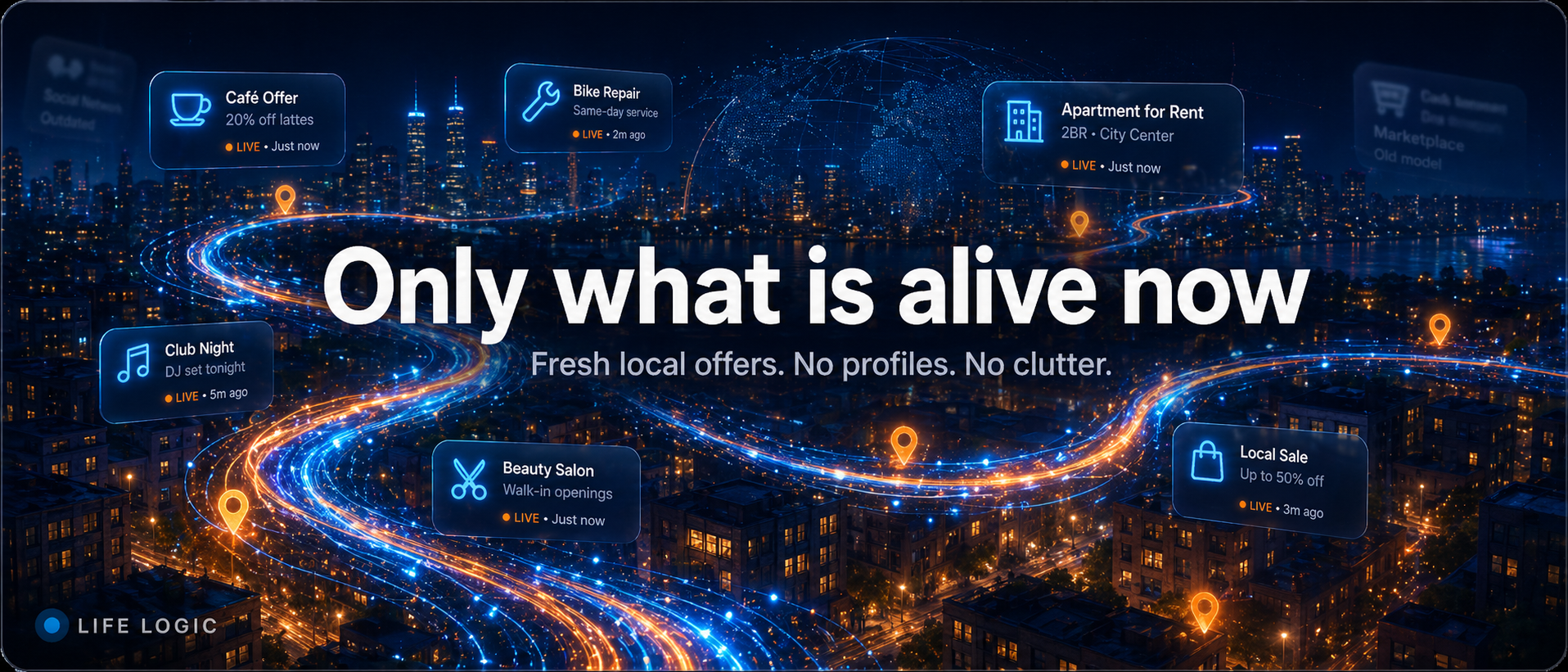
Infa is not a social network. It is not a marketplace. It is a living stream of local offers “here and now” — without endless profiles, archives or dead content.

Life Logic Core story of the Infa platform

Infa is not a network.
Infa is not a marketplace.
Infa is a living stream of local offers, right now.

We don’t store people.
We don’t store history.
We store what is alive, fresh and local.

That is the fundamental break from Instagram, TikTok, Facebook and Google — places where almost everything you see is old, repeated or irrelevant.


🔥 1. No registrations. Only email to activate a post or a reflink

Traditional accounts create noise: abandoned profiles, lost passwords, dead pages.

Infa works the other way around:

  • A person arrives, creates a post in a few seconds.
  • Confirms an email only when they need to pay or extend the post.
  • The post lives 1 or 6 months and then disappears automatically.

No profiles. No “forever photos”. No frozen timelines. In Infa, only what is relevant now stays visible.


🔥 2. No followers. No friends. No social graph

When you build a social network, you inevitably get drama, vanity and content for the sake of content.

In Infa, the user sees only:

  • their local zone;
  • the freshest and most important posts around them;
  • an AI-curated view of “what matters here right now”;
  • carefully placed promos from agents and ambassadors — without spam.

No follow buttons. No like-hunting. No endless stories. Just useful, real-world information in a specific place and time.


🔥 3. Life Logic Feed — an intelligent stream with no clutter

Classic feeds recommend people and emotions. The Infa feed focuses on behaviour in a zone and real offers.

The stream is built from:

  • fresh posts (recent days have more weight);
  • paid posts (even higher weight);
  • content from your city and a sensible local radius;
  • global posts when your local zone is still empty;
  • signals from AI Help — what people actually search for;
  • active partner zones and local curators.

And it automatically filters out:

  • duplicates;
  • weak or empty posts;
  • spam and abuse;
  • political and NSFW content that breaks the experience.

The result is not an archive. It is a stream that behaves like a living system.


🔥 4. Partners, agents and ambassadors as local curators

In Infa, partners are not extra admins sitting in a dashboard. Their work happens in the real zone, not inside a social UI.

They:

  • bring new posts and new people to the platform;
  • help local businesses and creators publish quickly;
  • earn a clear share through their referral code;
  • see analytics for their area;
  • never turn Infa into a closed club or a gatekeeper network.

Users create the stream. Partners amplify it. The system shares revenue transparently and stays clean by design.


🔥 5. The core principle of Life Logic

Infa is not memory. Infa is flow.

Like a river. Like air in a city. Like people moving through streets.
Every day — new offers. Every day — local activity.
Every day, the platform breathes and refreshes itself.

It’s not Google. It’s not Instagram. It’s not TikTok.
It’s a new layer of the internet that shows only what is alive right now in your city, your area, your corner of the world.

Article link copied